

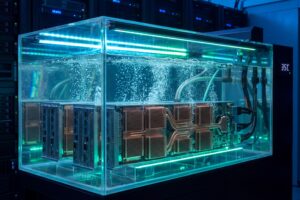
For decades, data center thermal design has relied on moving air. That approach is reaching its limits. As AI accelerator power densities exceed 1,000 watts per chip and rack power demands climb into hundreds of kilowatts, air cooling is no longer sufficient for many next-generation deployments. Liquid cooling, and increasingly immersion cooling, is moving from a specialized application to a mainstream requirement.
This transition introduces a critical materials-compatibility challenge for design engineers: How will tapes, polymer films, and coated fabrics perform under continuous exposure to, or full immersion in, dielectric cooling fluids compared with their performance in ambient-air environments?
For engineers specifying components for an immersion-cooled or direct-liquid-cooled system, materials that have performed reliably in air-cooled environments may not be suitable for the new operating conditions. Published compatibility data in this area also remains limited, since dielectric fluid chemistries vary by manufacturer and many films and adhesives have not been evaluated against them. This is an area where working with an experienced materials partner, capable of sampling, and fabricating to the specific application, provides a meaningful advantage. This blog outlines the key considerations and a practical path forward before finalizing a design.
What Changes When a Component Moves from Air to Fluid
Materials that perform reliably in ambient air may behave differently after prolonged exposure to dielectric immersion-cooling fluids. Several potential failure points deserve particular attention:
- Swelling and softening. Certain polymers absorb dielectric fluid over time, resulting in dimensional changes that can affect fit, adhesion, or mechanical clearance.
- Adhesive degradation. Some adhesive chemistries lose bond strength when exposed to certain types of chemicals and dielectric fluids. An adhesive that performs well for years in air may release or delaminate within months of fluid exposure.
- Extraction of additives. Plasticizers, stabilizers, and other additives in certain films and adhesives can leach into the surrounding fluid, altering both the material’s properties and the fluid’s dielectric performance.
- Short-term versus long-term compatibility. A material may pass a brief immersion test and still fail after months of continuous exposure. Compatibility should be evaluated against the intended exposure duration and duty cycle, rather than a short-term test that does not reflect actual operating conditions.
Adhesive Selection for Immersion Environments
Pressure sensitive adhesives are typically the most sensitive component in an immersion-cooled design, as adhesive performance depends heavily on the specific formulation used.
- Silicone adhesives generally demonstrate strong resistance to a wide range of fluids and perform well across temperature extremes, making them a common choice for immersion-adjacent applications.
- Acrylic adhesives vary considerably by formulation. Some are engineered specifically for solvent and oil resistance, while others may soften or lose adhesion relatively quickly under dielectric fluid exposure. Adhesive family alone is not a reliable indicator of performance, and standard datasheets often do not address this distinction.
- Rubber-based adhesives tend to be the most vulnerable to fluid exposure and are generally not recommended for direct immersion applications.
Although CS Hyde primary utilizes pressure sensitive adhesive lamination we can also supply etched polymers film that utilize a film treatment process that make them bondable with a variety of different adhesives, for example an epoxy-based system.
Films and Fabrics with Inherent Fluid Resistance
Where design flexibility allows, certain base materials substantially reduce compatibility concerns due to their chemical resistance nature:
- PTFE (Teflon™) films and coated fabrics are chemically inert to nearly all dielectric fluids and maintain performance across a wide temperature range, making them a dependable choice for gaskets, wraps, and insulation in fluid-contact applications.
- Polyimide (Kapton®) film provides excellent dielectric strength and thermal stability and generally performs well in fluid-immersed environments. As with other constructions, the adhesive backing typically requires closer evaluation than the base film itself.
- PFA and other fluoropolymer films share much of PTFE’s resistance profile with better mechanical properties.
From Material Selection to Finished Part
Identifying a compatible film, fabric, or adhesive system is only part of the task. Most immersion cooling and liquid cooling applications require that material in a specific width, shape, or format, often in dimensions that are not available as a standard stock item. This is where converting capability becomes a practical requirement rather than a convenience.
- Slit-to-width roll slitting allows base material to be supplied in precise widths ideal for cable wrapping, busbar insulation, or automated application processes, eliminating waste and inconsistences while maintaining tight tolerances.
- Die cutting produces consistent, repeatable parts, such as gaskets, insulating pads, or EMI shielding components, at volumes suited for production runs, with tolerances that manual cutting cannot reliably achieve.
- Sheeting converts roll-format material into flat sheets sized for component-level fabrication, prototyping, or further downstream processing.
- Dieless digital knife cutting supports rapid turnaround on prototype and low-volume parts without the lead time or cost of hard tooling, which is particularly useful during early-stage design validation when configurations are still subject to change.
Common Application Questions:
Before finalizing materials for a liquid- or immersion-cooled design, engineers should consider the following:
- What fluid, specifically, will be used? Single-phase dielectric fluid, two-phase fluorocarbon fluid, and glycol-based direct-to-chip coolants each present different compatibility profiles. “Immersion cooling” alone is not a sufficiently specific basis for material selection.
- Is the system single-phase or two-phase? Two-phase systems introduce boiling and condensation cycles that impose additional thermal and mechanical stress beyond simple submersion.
- What is the expected exposure duration and duty cycle? A component subject to intermittent contact performs very differently than one subject to continuous, multi-year immersion.
- What temperature range will the material experience in service? Fluid temperature combined with localized component heat can exceed a material’s rated range even when the fluid itself appears benign.
- Has the specific adhesive and fluid combination been tested, or only the base film? Compatibility data for a film provides limited insight into the performance of the adhesive laminated to it.
A Partnership Approach to Material Selection
Immersion cooling remains sufficiently new that much of the compatibility data engineers require is not yet available in a readily accessible, published form. Fluid chemistries vary by manufacturer, exposure conditions vary by rack design, and many films and adhesives on the market are characterized by entirely different operating environments. Addressing this reliably is less a matter of locating the correct data sheet and more of working with a materials partner capable of evaluating available data, offering suggestions, and providing samples for direct testing. This is where CS Hyde’s role as a custom converter is most relevant. CS Hyde works routinely with a wide variety of films, fabrics, and a range of silicone and acrylic pressure sensitive adhesive tapes.